Compare VPS Hosting India Providers 2026: How to Actually Choose the Right Provider
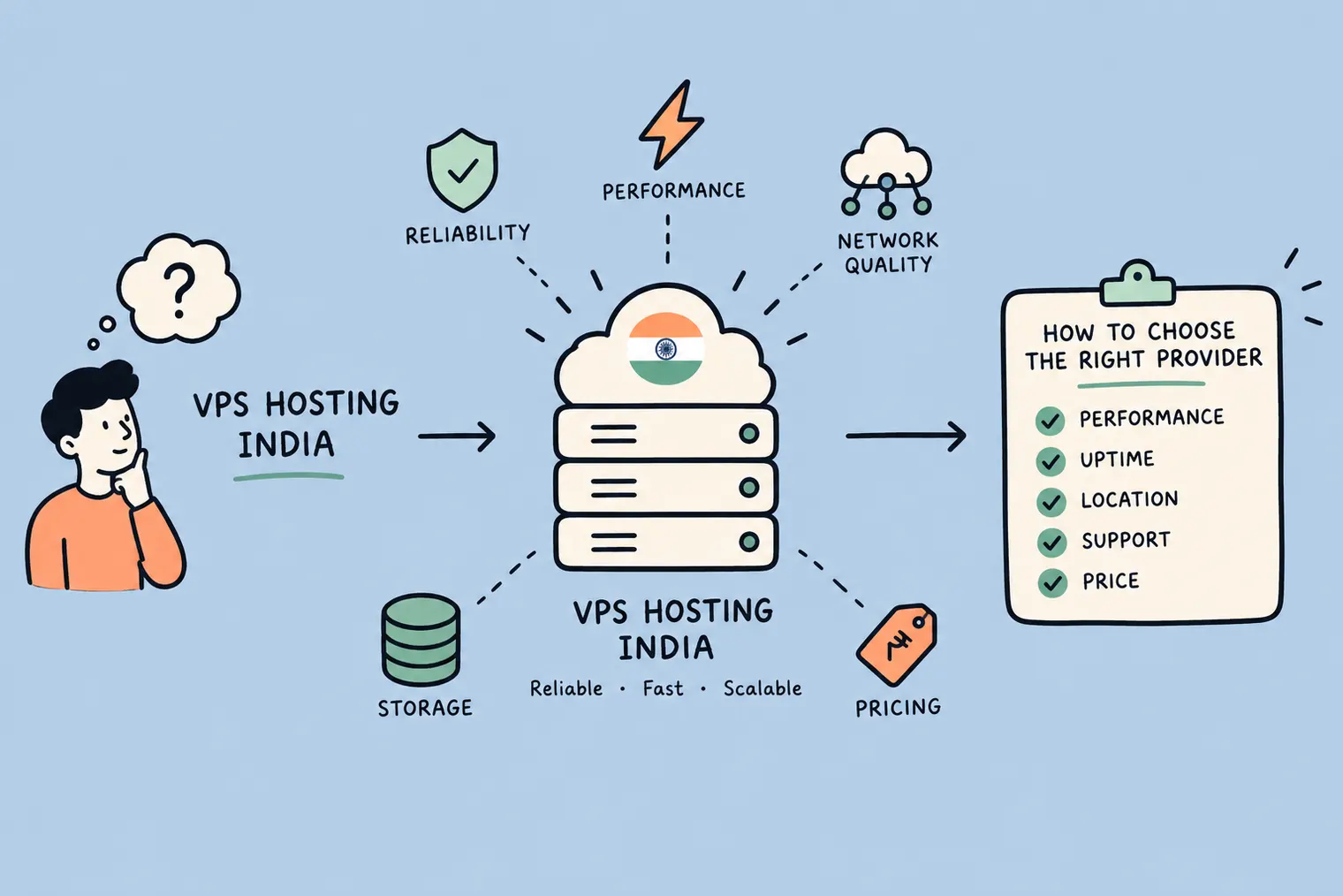
What is the best VPS hosting India in 2026? → There's no single "best" VPS host in India — the right one depends on your requirements, whether you need hourly, no-contract billing, a fixed monthly plan with cPanel, or raw performance for a database workload. Iotamine VPS, Hostinger, MilesWeb, DigitalOcean, Vultr and BigRock each hosting company wins for a different use case, and this guide breaks down exactly which one fulfils your requirements.
⚡ Quick Summary
Server location matters more than the brand name: a VPS in Mumbai, Noida, or New Delhi cuts latency for Indian users to under 15ms, versus 150ms+ from a US or European data center.
Billing model changes your real cost: most Indian VPS providers lock you into annual plans to get their advertised price; hourly billing (like Iotamine's) means you pay only for what you run, no contract.
"Cheap" and "cost-effective" aren't the same thing: a ₹289/month plan with 1 vCPU and 1GB RAM will choke the moment your app gets real traffic.
Managed vs. unmanaged depends on your workload, not just your budget — pick unmanaged only if you're comfortable patching your own server.
For India-facing SaaS, e-commerce, or WordPress sites, low latency to Delhi/Mumbai users beats a marginally cheaper server in Singapore or the US.
What Is VPS Hosting, and Why Does It Matter for Indian Websites?
A Virtual Private Server (VPS) splits one physical machine into isolated virtual servers, each with its own dedicated CPU, RAM, and storage — so your site's performance never depends on what your "neighbour" on shared hosting is doing.
You've probably outgrown shared hosting the hard way: a traffic spike hits, your site crawls, and you check and refresh cPanel again and again, wondering what changed. Nothing changed. Someone else on your server got a traffic spike too, and shared hosting made it your problem.
Here’s the thing: this isn’t a bug or a critical shared-hosting issue. It's the entire model.
Think of shared hosting like a PG (paying-guest) accommodation. You've got your room, but the kitchen, the water tank, and the Wi-Fi router are all shared. One guy's continuous Netflix session in ultra 4K quality slows the internet for the whole floor. A VPS is your own 1BHK flat in the same building: your own water connection, your own electricity meter, and your own space. Nobody else's usage touches yours, yo can easily watch Netflix session in ultra 4K quality slows.
That isolation is why VPS hosting has become the default upgrade path for WordPress sites doing 50,000+ monthly visits, growing SaaS products, and e-commerce stores running Diwali or Republic Day sale traffic three scenarios where shared hosting reliably falls over in India.
But knowing what a VPS is only gets you halfway. The real question is which one actually works and performs well for an Indian audience and that comes down to something most buying guides skip entirely: where the server physically sits.
Why Does Server Location Matter for VPS Hosting India?
Server location determines latency the time it takes data to travel between your server and your visitor and for Indian audiences, a server in Delhi or Mumbai can respond in 10–15ms versus 150–250ms from a US or European data center.
It is very simple: your local shop and warehouse should be in the same city.
Let's be direct: latency is the single most underrated factor in VPS shopping.
A US-based VPS provider can offer you double the RAM for the same price. Sounds like a win until you check where their servers actually are. Cheaper often means the "India" listing is really Singapore or Frankfurt with a marketing label slapped on.
Iotamine, for example, runs a live New Delhi region with 11ms average latency for Indian traffic and 99.97% uptime over a 90-day window measured, not promised. Compare that to routing through a Southeast Asian data center, and you're looking at 5–10x the response time before your application even starts processing the request.
Why this matters for SEO too: Google's Core Web Vitals directly factor in Time to First Byte (TTFB). A slow server in the wrong region doesn't just annoy your visitors it quietly tanks your search rankings alongside your bounce rate. Other search engines acknowledge this too.
Quick check before you buy: ask any provider for their actual data center city and run a ping or traceroute test yourself. Don't take "India-optimized" at face value — verify it in under two minutes from your terminal.
Location solves half the equation. The other half is what kind of VPS you're actually buying and in India, that split gets confusing fast.
What Types of VPS Hosting Are Available in India?
Indian VPS hosting splits into three key decisions: managed vs. unmanaged, fixed-tier vs. fully configurable resources, and monthly billing vs. hourly billing — and each choice changes both your cost and your workload.
VPS Hosting vs. Cloud VM: What's the Real Difference?
Most providers on this list sell traditional VPS hosting — compute, disk, and IP address are bundled into one unit. Delete the VPS, and everything tied to it usually goes with it.
Iotamine runs on a different model, technically closer to a Cloud VM: compute, storage, and network are three separate, independently billed resources. You can detach a disk and move it to another instance, or keep an IP address even after destroying the VM it was attached to. It's a subtle distinction, but it's the reason the flexibility claims later in this guide actually hold up it's a different underlying architecture, not just marketing language.
Managed vs. Unmanaged VPS
Managed VPS means the provider handles OS updates, security patches, and server monitoring — you focus on your app, and they keep the lights on. Unmanaged means you're the sysadmin.
Choose managed if: you're a business owner or marketer with no dedicated DevOps person. Choose unmanaged if: you or your team already run Linux servers and want full root control without paying for hand-holding you don't need.
Fixed-Tier Plans vs. Fully Configurable Resources
Most Indian VPS providers — BigRock, MilesWeb, and similar hosts — sell you locked plan tiers: Plan A gets 1 vCPU and 2GB RAM, Plan B gets 2 vCPU and 4GB RAM, and there's nothing in between. Need 3 vCPU and 6GB? You're overpaying for Plan C.
Iotamine takes the opposite approach: dial in 1 to 32 vCPUs and 2GB to 64GB RAM, choose exact storage and IP counts, and resize it later without rebuilding the server. It's the difference between buying a fixed combo meal and building your own thali — you pay for exactly what you're actually eating.
Monthly Billing vs. Hourly Billing
Here's what most people get wrong: an advertised "starting price" on an Indian VPS host is almost always the annual pre-paid rate. Pay monthly, and the real price jumps 30–50% higher. Cancel early, and most providers don't refund the unused months.
Hourly billing works differently — you're billed only for the hours a server actually runs, tracked from creation to termination, with no minimum contract. Spin up a server for a two-week product launch, tear it down after, pay for exactly those two weeks.
Bottom line: the "type" of VPS you need isn't about brand loyalty — it's about matching the billing model and resource flexibility to how your business actually operates. Now let's turn that into an actual buying checklist.
How Do You Choose the Best VPS Hosting Provider in India?
The best VPS hosting provider in India is the one whose data center location, resource flexibility, and billing model match your actual traffic pattern — not the one with the lowest homepage number.
Here's a checklist, followed by a real side-by-side comparison of providers currently active in the market:
Confirm the data center is genuinely in India — Delhi, Mumbai, Noida, or Chennai, verified via traceroute.
Check the renewal price, not the intro price — search "[provider name] renewal pricing" before you commit.
Match resources to your actual app, not a generic tier — a WordPress blog and a Node.js API server have wildly different RAM needs.
Confirm root access and OS choice — Ubuntu, AlmaLinux, Rocky Linux, or Debian should all be available.
Ask what happens if you need to scale mid-month — can you resize in place, or do you rebuild from scratch?
Provider | Starting Price (~2GB RAM tier) | Billing Model | India Availability | Standout Feature |
₹548/mo (1 vCPU, 2GB RAM, 15GB SSD, 1 IP) | Hourly, no contract | New Delhi (dedicated region, 11ms, 99.97% uptime) | Cloud VM — compute/storage/IP independently detachable | |
Hostinger | ₹599/mo | Monthly/annual | India-region KVM plans | Up to 8 vCPU/32GB on higher tiers, one-click app templates |
BigRock | ₹289/mo (1-year plan) | Monthly/annual | India | Recognizable Indian brand, phone support |
MilesWeb | Budget-tier plans (varies) | Monthly | India | Root access on VPS plans; cPanel available as a paid add-on on select plans, not bundled by default |
DigitalOcean | ~$12/mo (~₹1,056) for a comparable 2GB config | Monthly, per-second billed | Bangalore region (cheapest $4 plan restricted in some regions — verify at signup) | Large global developer community, mature docs |
Vultr | ~$12/mo (~₹1,056), High Frequency tier | Monthly/hourly | Mumbai & Delhi NCR regions | 33 global regions, AMD EPYC-based compute |
Akamai (Linode) | ~$12/mo (~₹1,056) | Monthly/hourly | Mumbai & Chennai regions | Developer cloud since 2003, strong documentation |
E2E Networks | Not consistently published for small instances | Monthly/hourly | India (Delhi/Mumbai) | Best known for GPU/AI compute, not general-purpose VPS |
A note on the international providers above: the DigitalOcean, Vultr, and Akamai figures are approximate INR conversions from USD pricing and will move with the exchange rate — they aren't fixed rupee prices the way the Indian providers' numbers are.
A word of caution here: comparison tables like this go stale fast — providers change pricing every few months. Treat this as a starting shortlist, not gospel, and always re-verify current pricing on the provider's own page before you buy.
Notice the pattern? Every fixed-plan provider in that table competes on either price or feature bundles. Iotamine's angle is different — it removes the "pick a tier and live with it" problem entirely by letting you configure exact resources and pay only for the hours you use them.
That flexibility sounds great on paper. But what does it actually cost you in rupees? Let's do the math.
How Much Does VPS Hosting Cost in India?
VPS hosting in India typically starts between ₹289 and ₹600 per month on annual plans for entry-level specs (1 vCPU, 1–2GB RAM), while fully configurable hourly billing lets you match cost exactly to resource usage instead of buying into a fixed tier.
Here's the math most "starting from ₹X" banners hide from you.
Take a genuinely comparable entry config — 1 vCPU, 2GB RAM, 15GB SSD storage, one IP address — priced on Iotamine's published New Delhi rate card:
Resource | Rate (New Delhi) | Monthly Cost (30 days) |
1 vCPU | ₹0.5000/hr | ₹360.00 |
2 GB RAM | ₹0.0420/hr × 2 | ₹60.48 |
15 GB SSD | ₹0.0026/hr × 15 | ₹28.08 |
1 IPv4 address | ₹0.1389/hr | ₹99.97 |
Total | ~₹548/mo |
Let's be straight about this: at this entry spec, Iotamine's ₹548/mo sits between BigRock's ₹289/mo and Hostinger's ₹599/mo — and comfortably below the ~₹1,056/mo that DigitalOcean, Vultr, or Akamai charge for a comparable 2GB configuration once converted from USD. If you're comparing purely against budget Indian hosts, Iotamine isn't the cheapest option. If you're comparing against the international clouds developers often default to, it's meaningfully cheaper — while still being a true Cloud VM, not a bundled VPS.
Where the math flips further in Iotamine's favor is the moment your needs sit between two fixed tiers. Traditional providers sell locked plan steps — 1 vCPU/2GB, then a jump straight to 2 vCPU/4GB, with nothing in between. Need 3 vCPU and 6GB RAM? You're paying for the next full tier up, whether you use all of it or not. That's a step-function cost curve: your bill jumps in big chunks every time you outgrow a tier.
Iotamine's billing scales linearly instead — dial in exactly 3 vCPU and 6GB, and you pay for exactly that, not the next fixed bracket. The advantage isn't just the entry price — it's what happens six months later when your app has actually grown and you're not stuck re-platforming to a bigger plan just to get 1 extra GB of RAM you needed.
Hidden costs to check before you sign up with anyone:
Backup and snapshot fees (often billed separately)
Bandwidth overage charges beyond the included allowance
Migration fees if you decide to leave
Now that you have the VPS hosting pricing, here's how it plays out for a real, small workload.
A quick example: say you're a developer building a small inventory and billing app for a family business — React, Node.js, PostgreSQL, maybe 2-3 people using it at the same time. Most of the expert advice online points you to either a free server (like Oracle's, which is real but often stuck on "no capacity available") or a fixed-price budget VPS (like Hostinger's ₹500/month plan) that's sized bigger than you actually your actual project requirements.
For a workload this light, a 1 vCPU, 1GB RAM, 10GB storage server is genuinely stronger than you need and enough for any simple project—Ubuntu, PM2, Nginx, and Postgres on the same box, running within an afternoon. Priced hourly on Iotamine, that exact setup costs ~₹548/month- cheaper than the fixed budget plan, hosted in Delhi, with no annual lock-in if the project doesn't pan out.
Ready to Test a VPS That Doesn't Lock You Into a Plan?
Iotamine runs live regions in New Delhi (11ms latency) and Frankfurt, with fully configurable vCPU, RAM, and storage — no fixed tiers, no annual contract. Boot volumes and IP addresses are detachable resources you can move between servers, and we bill hourly from the moment your VM boots.
Start with $10 in free credit — no credit card required, cancel anytime.
Deploy a VM → · See live pricing →
Final Word: Is VPS Hosting India Right for You?
Best VPS hosting India 2026: the right answer depends on your workload — there's no universal winner.
Server location is non-negotiable: verify the actual India data center, don't trust the label.
Billing model changes real cost: hourly, no-contract billing suits growing and unpredictable workloads; annual plans occasionally edge ahead for fixed, always-on servers.
Check renewal pricing before intro pricing — the advertised "starting from" number rarely survives past year one.
Try before you commit: Iotamine's $10 free credit lets you test real New Delhi latency without a card on file.
FAQ
What is the best VPS hosting in India for beginners?
For beginners, a managed VPS with a simple dashboard — no command-line requirement is the safer starting point. Look for one-click OS deployment, root access you can ignore if you don't need it, and support that responds directly rather than through a ticket queue.
What operating systems can I install on an Indian VPS?
Most modern VPS providers support Ubuntu, AlmaLinux, Rocky Linux, and Debian at minimum, with root access to install anything else Linux can run — Docker, Node.js, Python, PHP, or a full WordPress stack.
Is a VPS enough for an e-commerce store during sale season?
A properly sized VPS with 4+ vCPUs and 8GB+ RAM handles most mid-sized e-commerce traffic spikes fine. For very high-traffic sales events, confirm you can resize resources on demand rather than discovering the limit mid-sale.
an I upgrade my VPS resources later without downtime?
It depends on the provider. Some require you to migrate to a new plan tier, which can mean downtime. Providers offering in-place resizing let you scale vCPU, RAM, and storage from the console without rebuilding the server.
Is hourly VPS billing cheaper than monthly plans in India?
For short-term, growing, or unpredictable workloads, yes — you pay only for the hours you actually run the server, with no annual lock-in. For a server running 24/7 all year at a fixed size, a discounted annual plan can occasionally be marginally cheaper.